|
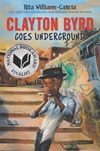
Clayton Byrd Goes Underground

Last updated Friday, March 13, 2026
Author: Rita Williams-Garcia
Illustrator: Frank Morrison
Date of Publication: 2017
ISBN: 0062215914
Grade Level: 5th (GLCs: Click here for grade level guidelines.)
Date(s) Used: Mar. 2026
Synopsis:
Clayton feels most alive when he's with his grandfather, Cool Papa Byrd, and the band of Bluesmen - he can't wait to join them, just as soon as he has a blues song of his own. But then the unthinkable happens. Cool Papa Byrd dies, and Clayton's mother forbids Clayton from playing the blues. And Clayton knows that's no way to live.
Armed with his grandfather's brown porkpie hat and his harmonica, he runs away from home in search of the Bluesmen, hoping he can join them on the road. But on the journey that takes him through the New York City subways and to Washington Square Park, Clayton learns some things that surprise him.
| Note to readers: |
| • |
The kids will ant to finish the book. Clayton will have an “adventure” underground (takes subway by himself). They will also learn why Clayton’s mom is so angry and against music.
|
| Discussion topics for before reading: |
| • |
This book is about a boy who loves to play “The Blues” with is grandfather; a well known musician.
|
| • |
Do you know what “The Blues” are? (see vocabulary).
|
| • |
What kind of music do you like?
Vocabulary:
|
| • |
The Blues: a style of jazz or popular music using harmonic and phrase structures of blues. It is characterized by the call-and-response pattern, the blues scale, and specific chord progressions, of which the twelve-bar blues is the most common. Blue notes (or "worried notes"), usually thirds, fifths or sevenths flattened in pitch, are also an essential part of the sound. Blues shuffles or walking bass reinforce the trance-like rhythm and form a repetitive effect known as the groove. This structure consists of a line sung over the first four bars, its repetition over the next four, and a longer concluding line over the last bars.
|
| • |
guitar: a flat-bodied stringed instrument with a long fretted neck and usually six strings played with a
pick or with the fingers.
|
| • |
keyboard: a musical instrument that is played by means of a keyboard, like a piano.
|
| • |
percussion: the beating or striking of a musical instrument such as a drum.
|
| • |
harmonica: a small rectangular wind instrument with free reeds recessed in air slots from which tones
are sounded by exhaling and inhaling.
|
| Discussion topics for during/after reading: |
| • |
Do you play a musical instrument? What is it? Why did you start playing?
|
| • |
If you don’t play an instrument but would like to, what would it be?
|
| • |
After the chapter “Takers” beginning on Page 26: Why do you think Clayton’s mother is so determined
to sell off Grandpa’s things? Why did she allow only traditional church music be played at the funeral?
|
| Craft ideas: |
| • |
Draw a picture of a musical instrument that you play or would like to learn to play.
|
| • |
St. Patrick’s Day is Tuesday, March 17th . Easter is Sunday, April 5th . Make a greeting card for someone.
|
| • |
On St. Patrick’s Day it is traditional to wear something green. Make yourself something green to wear. Make a four-leaf clover out of green construction paper or make one out of white paper and color it
green.
|
| Special activities: |
| • |
Do the word search
|
*Note: These craft ideas are just suggestions.
You can use them, but you don't have to use them.
You can expand upon them, or add your own twist.
Remember, though, that the focus of your time should
not be on the development and execution of a craft;
the focus should be on the read-aloud and the
enjoyment of the book!
|